Why your enterprise creative team shouldn't be making most of your videos
The wrong-work problem in enterprise creative teams
A creative director at a large B2B research and advisory firm put the problem plainly: her editorial team had "too many people doing the wrong work." Editors were spending their days on file-handling and administrative production tasks—exporting variants, managing asset libraries, preparing files for distribution—instead of the creative decisions that actually required their expertise. The talent was in the room. It was just pointed at the wrong problems.
This is one of the most consistent structural failures in enterprise video production. Creative teams staffed with motion designers, video producers, and brand specialists end up absorbing a production workload that was never designed to match their skills. The result is predictable: the organization's highest-cost creative resources are occupied with its lowest-value tasks, while the work that actually requires creative judgment waits in queue.
The wrong-work problem in enterprise creative teams isn't a performance issue. It's a routing issue—and the distinction matters, because the fix is entirely different.
How enterprise creative teams end up doing the wrong work
Centralized creative production made sense when video was expensive, technical, and rare. When a company produced a handful of brand videos per year, routing every request through a specialized team was the right call. The team had bandwidth; the requests were genuinely complex.
That model didn't adapt when video volume scaled. Marketing teams now need video for campaigns, sales enablement, product launches, events, and account-specific outreach. Demand that once arrived as ten requests per quarter now arrives as two hundred.
The creative team—still organized as a centralized production function—becomes the bottleneck.
A marketing director at an HR technology company described exactly this dynamic: "We are trying to figure out how we can ourselves start to build these out—and not be limited by other groups that say they just can't help." The creative team wasn't failing to deliver because of a talent gap. It was failing to deliver because a centralized routing model had been applied to a distributed production problem.
A creative producer at a global social media platform described how this plays out at the template level: marketing stakeholders "always want to break the template—but the template can't bend." In practice, that meant the creative team spent its time managing exceptions—fielding requests for modifications, negotiating what could and couldn't change, processing one-off adjustments—instead of building systems that would prevent those conversations from happening in the first place.
What happens to creative output when production is centralized
There are two direct consequences when enterprise video production is routed primarily through the creative team.
The first is that the creative team's output capacity gets consumed by routine production. Motion designers who could be building new visual systems spend their time resizing exports. Creative directors who should be setting brand direction spend their time reviewing administrative requests. The strategic work gets deferred—or it happens at the margins, in whatever time remains after the queue is cleared.
The second consequence is that the broader organization stops asking. When every video request requires creative team involvement and the creative team has a two-to-three-week queue, teams with time-sensitive needs find workarounds. They shoot on phones. They use off-brand templates from free tools. They skip video entirely.
This is exactly what happened at one enterprise data cloud company's ABM program. Two people—an ABM specialist and a marketing manager—were trying to service 50 account executives and 200 to 250 target accounts. The creative team was not involved in this workflow at all: there was no practical way to route 200-plus account-specific video requests through a centralized production function. The result was that no video got made.
When the creative team becomes the ceiling on video production volume, the organization doesn't just slow down—it stops.
The difference between a creative team that produces and one that enables
A creative team organized as a production center accepts all incoming requests, produces all output, and reviews all work before it ships. Every video flows through the team. Quality is consistent because control is centralized. But the team's capacity is also the organization's production ceiling—and that ceiling is low.
A creative team organized as infrastructure does different work. It builds the systems—templates, component libraries, style guides, approved asset sets—that allow other parts of the organization to produce brand-compliant video without creative team involvement on every asset. It sets the guardrails, governs the standards, and handles the genuinely complex work that requires specialist judgment. Routine production gets distributed to the teams that need it.
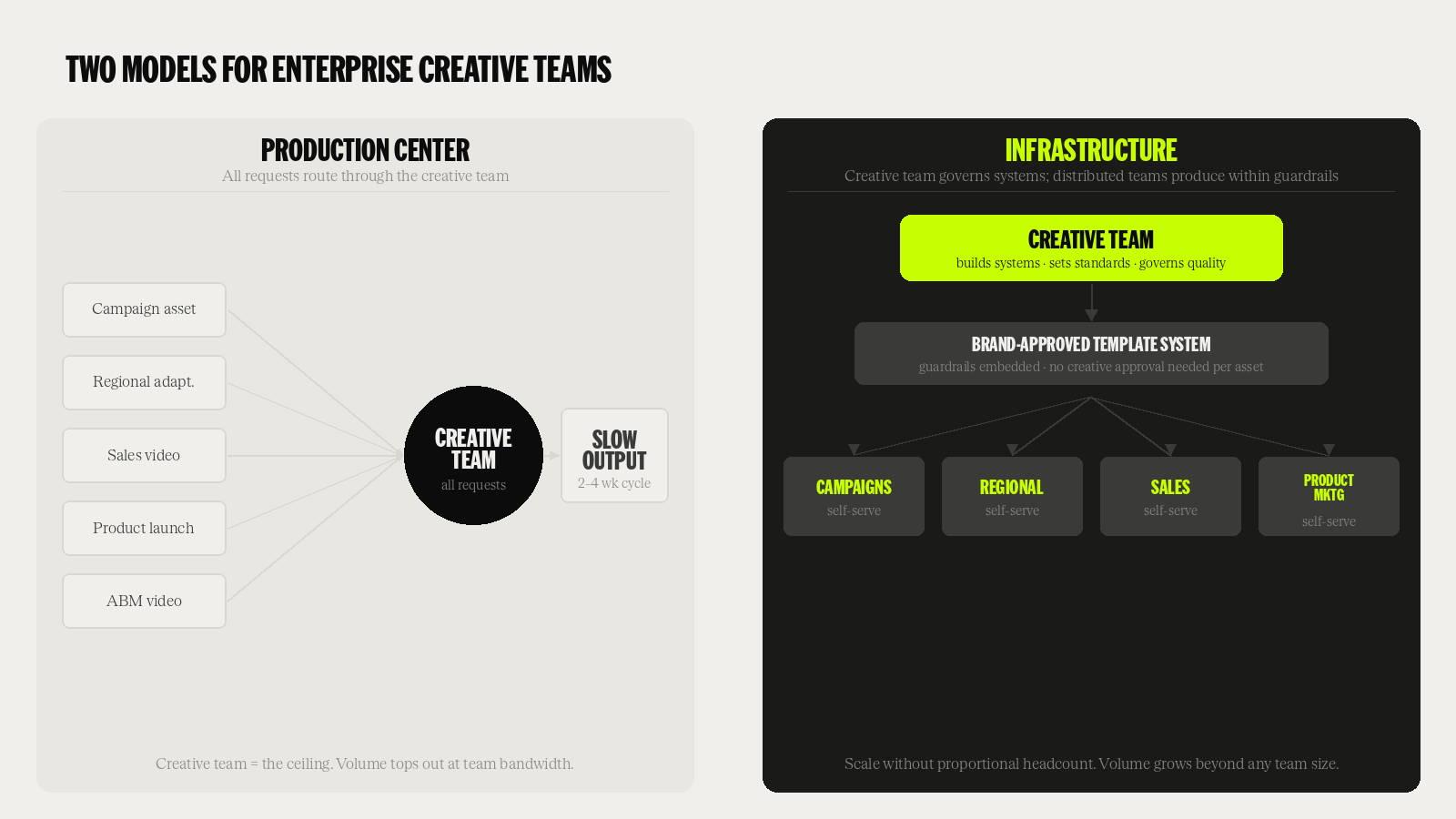
The distinction is not about lowering standards. It's about recognizing that most of the video an enterprise organization needs does not require the expertise of a motion designer or creative director to produce—it requires their expertise to design the system within which it's produced.
Because our non-design focused team members are empowered to create stunning videos of their own, our motion graphics designers and videographers are now focused on the types of projects that can drive the greatest impact.
Creative Director, large enterprise software company
How to restructure enterprise video production around creative team strengths
The enterprises that have made this shift consistently report the same outcome: the creative team produces more strategic work, not less. The overall volume of video produced by the organization increases substantially. And the creative team stops being the bottleneck—because the model was redesigned to stop treating them as one.