Build, Hire, or Buy: How enterprise marketing leaders are solving the video capacity problem
The question surfaces in nearly every strategic planning cycle at enterprise marketing organizations right now. Video demand is increasing—from sales, from demand generation, from product, from field teams—and the existing production model cannot keep pace. A CMO at a B2B research and analyst firm put it plainly: "There's real demand for this. The question we're asking is: do we just not do it, do we hire someone, or is there another option?"
That framing—do nothing, hire, or find another option—is exactly where most enterprise marketing leaders sit when they first confront a video capacity gap. The decision is consequential: the wrong path costs budget, headcount, and time, and still doesn't close the gap. The right path depends on factors specific to each organization's structure, volume requirements, and creative standards.
The three-way decision most enterprise marketing leaders are making about video right now
Enterprise video capacity has become a structural problem. A single enterprise data cloud company, running its in-house video production program at maximum capacity, was capped at 15 videos per month—and delivered one video in an entire quarter. The same team, after implementing a self-serve production model, set a target of 50 to 75 videos per quarter from the ABM team alone. That gap between 1 and 50 is not closed by adding one more videographer. It requires a structural change to how video production is organized.
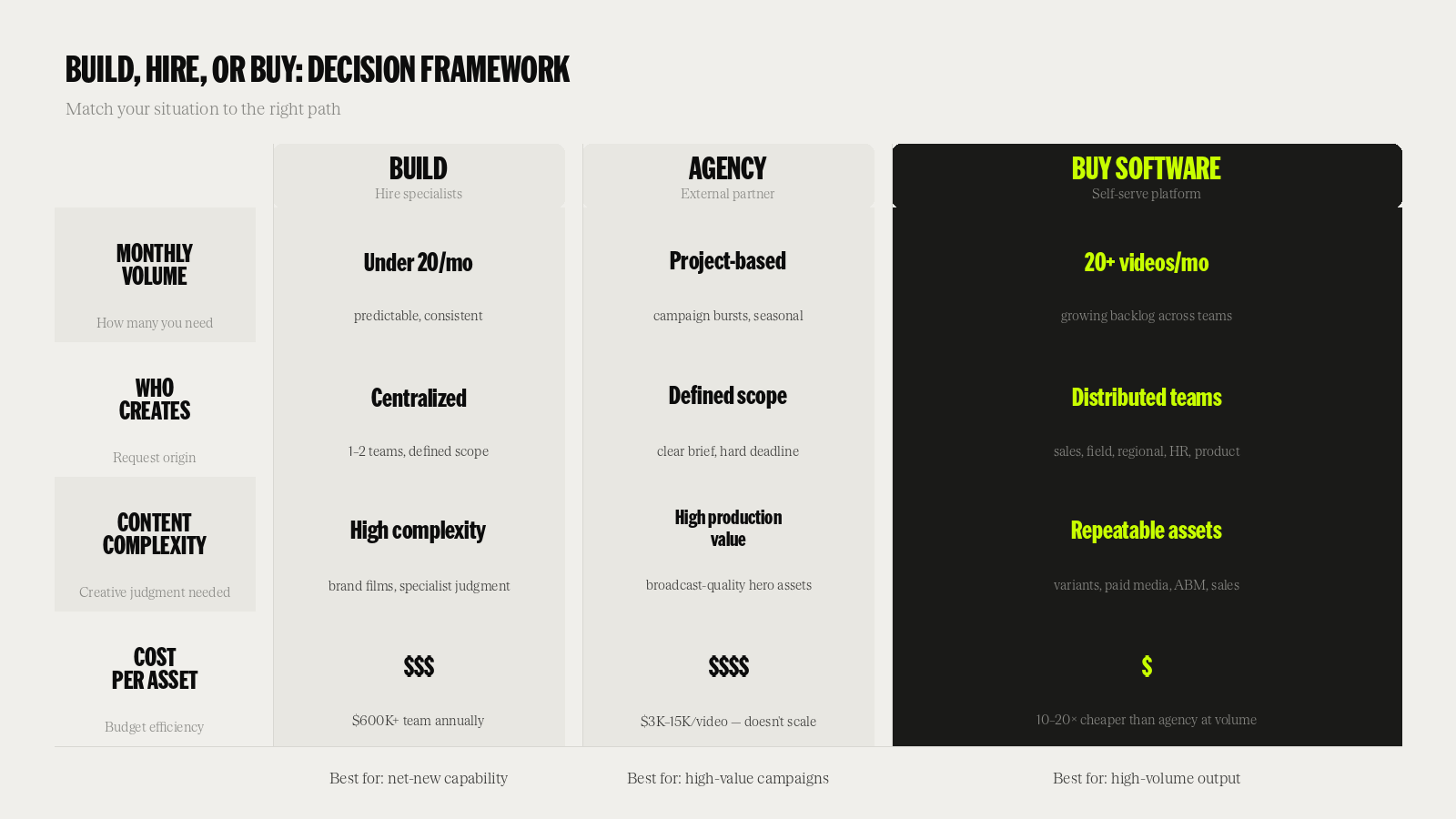
Three structural options exist: build internally by hiring video specialists; buy externally through an agency or production partner; or buy software by implementing a self-serve video platform. Each has a different cost structure, a different ceiling, and a different set of organizational dependencies.
Option 1: Build it (hire more video specialists)
Expanding an in-house video team is the default answer at most enterprise organizations, and in many cases it is the right one. Internal teams understand brand standards, have access to stakeholders, and can iterate faster than external partners on complex, context-dependent content. When video volume is predictable, subject matter is consistent, and quality control is non-negotiable, in-house production is a strong foundation.
The problem is the cost structure at scale. A mid-level video specialist in a major market costs $90,000 to $120,000 in base salary, before benefits, equipment, software licenses, and management overhead. A team capable of producing 20 to 30 high-quality videos per month requires multiple editors, a producer, and motion graphics support—a fully loaded annual cost north of $600,000, before any surge capacity.
More critically, hiring does not distribute production. A creative director at a major enterprise software company described the pre-software reality on her team: videographers were fielding requests from every department, acting as the single point of failure for all video output. When her organization implemented a self-serve video platform, the result was significant.
We suddenly went from a team of a few videographers to hundreds of video creators across multiple departments. Our motion graphics designers are now focused on projects that actually require their expertise.
Creative Director, major enterprise software company
Hiring is the right primary lever when the organization is building a net-new capability, quality requirements demand human creative judgment throughout, or video volume is low and predictable. Hiring is the wrong primary lever when the volume requirement exceeds what any realistic team size could produce, or when the primary bottleneck is distribution.
Option 2: Buy it (hire an agency or production partner)
Agencies solve a specific problem: skilled production capacity without permanent headcount. For campaigns with defined scopes, hard deadlines, and high production value requirements, an external production partner often makes more economic sense than staffing for the peak.
The trade-off is velocity and responsiveness. A paid media director at an HR tech company was managing an external production agency based internationally for every creative asset. The agency produced quality work—but it also meant zero internal creative velocity. Every revision cycle, every new asset, every copy test required a formal request, a scheduling conversation, and a multi-day turnaround. The organization had outsourced not just production but its ability to respond quickly to market conditions.
Agency economics also do not scale linearly with volume. A single 60-second video might cost $3,000 to $15,000 from a mid-market agency. At 50 videos per quarter, that math produces an annual spend of $600,000 to $3 million—for a volume that, with the right software infrastructure, a small internal team could facilitate at a fraction of that cost.
Option 3: Buy software (self-serve video platform)
Self-serve video platforms redistribute production capacity. Instead of routing all video requests through a central creative team or an external partner, they allow non-specialist team members to produce brand-compliant video within guardrails set by the creative team.
A growth marketing manager at a digital health company managing 2,800 enterprise clients was operating under organizational pressure to demonstrate that AI tools could replace headcount requests—not supplement them. A self-serve platform answered that requirement in a way that neither hiring nor an agency could: it turned video production from a centralized function into a distributed capability.
The limitations are real. Self-serve platforms require thoughtful template architecture and creative oversight to maintain quality standards. They are not a substitute for human creative judgment on high-complexity, high-visibility projects. And they require organizational change management. For enterprise organizations with high video volume requirements, multiple internal stakeholders generating video requests, and budget pressure to reduce cost-per-asset, a self-serve platform is typically the highest-leverage primary investment.
How to evaluate which option is right for your organization
Why most enterprise teams end up combining two of the three
The cleanest answer—pick one option and commit—is rarely what enterprise organizations actually land on. The more common outcome is a primary investment in software combined with a retained agency relationship for high-complexity work, or an internal team focused on creative strategy and quality oversight, while distributed teams handle volume production through a self-serve platform.
The mistake most organizations make is trying to solve a volume problem with a quality tool. A videographer hired to handle 150 video requests per quarter is being set up to fail. An agency managing 50 monthly assets at enterprise revision cycles will consume the budget before the quarter closes.
The organizations that close the video capacity gap—and sustain it—identify which part of their production problem is a volume problem and which part is a complexity problem, then match the right solution to each. That architecture is not complicated in concept. The difficulty is in naming the problem accurately before committing to a solution.